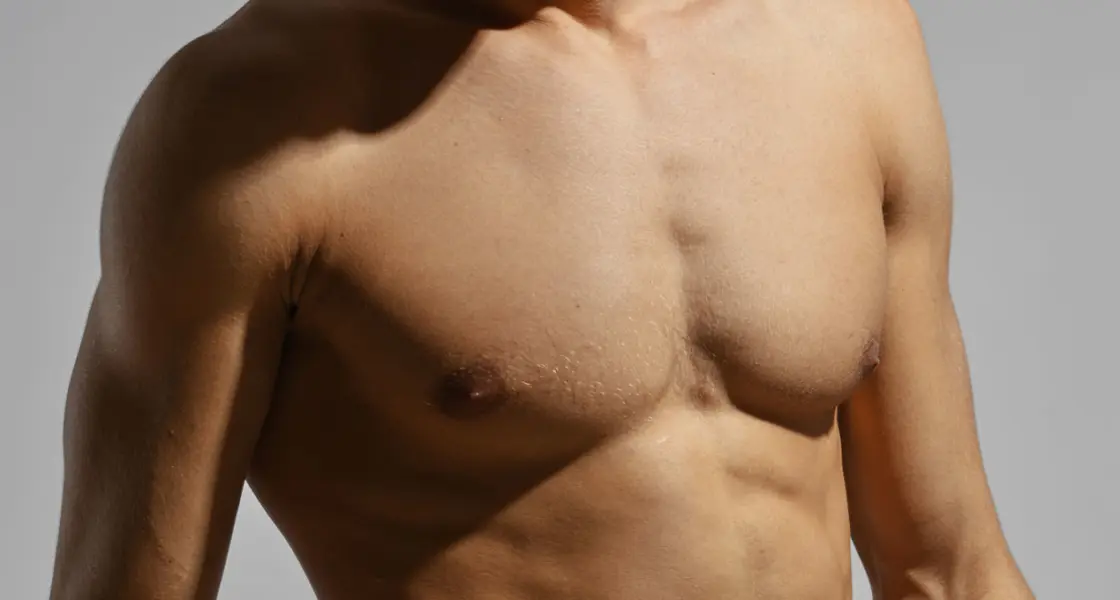
Gynaecomastia, the development of excess breast tissue in men, is something I see regularly in consultation, and it’s a condition that tends to carry a disproportionate amount of quiet embarrassment. Most men spend years adjusting their clothing, avoiding certain activities, or simply not mentioning it before they decide to find out what can actually be done.
If that sounds familiar, this post is for you. I want to explain what gynaecomastia actually is, what causes it, and how to know whether surgery is the right route, or whether something else needs to happen first.
Glandular tissue versus fat and why it matters
Not all male breast enlargement is the same, and the distinction genuinely affects what treatment looks like. True gynaecomastia involves actual glandular breast tissue, which is the same tissue that forms in female breast development, sitting beneath the nipple as a firm, disc-like mass. It doesn’t respond to diet or exercise because it’s not fat. It’s gland, and it needs to be removed surgically.
What’s sometimes called pseudogynaecomastia is different — this is fatty enlargement of the chest without a true glandular component. It’s much more common in men who carry excess body weight generally, and it can improve significantly with fat loss. Liposuction alone tends to work well here.
In practice, most of the men I see have some combination of both, a glandular disc plus an element of fatty fullness around it. The relative proportion of each is something I assess during consultation, because it determines the surgical approach.
What actually causes it?
The short answer is a shift in the balance between oestrogen and testosterone. Even a subtle change in that ratio in favour of oestrogen can trigger breast tissue development in men. This happens for a range of reasons: hormonal changes in puberty (very common and usually temporary), age-related testosterone decline, certain medications, including some antihypertensives and antidepressants, anabolic steroid use, or underlying conditions affecting hormone metabolism.
In a significant number of cases, no specific cause is ever identified. That’s known as idiopathic gynaecomastia, and it’s frustrating for patients who want a clear explanation, but it doesn’t affect the surgical approach.
What I would always recommend before considering surgery is a conversation with your GP and to do some basic blood tests, hormone levels, liver function, and thyroid checks. Not because something sinister is likely, but because ruling out a treatable underlying cause is the right starting point. If a medication is contributing, changing it may help. If a hormonal imbalance is identified, that should be managed before any surgical discussion.
Before any surgical consultation, ask your GP to check hormone levels, liver function, and thyroid function, and to review your current medications.
Surgery is appropriate once an underlying medical cause has been excluded or addressed and the enlargement has been stable for at least 12 months.
When surgery becomes the right conversation
For men with true glandular gynaecomastia that has been present for more than a year and isn’t resolving on its own, surgery is usually the only effective treatment. The gland doesn’t shrink with weight loss, and it won’t respond to topical treatments or supplements, whatever manufacturers might claim.
The decision to pursue surgery tends to come down to a few things: how significantly the appearance is affecting daily life, whether clothing choices or physical activities are being driven by self-consciousness about the chest, and how long the patient has been living with it. These are personal considerations, and there’s no universally right answer, but they’re the things worth reflecting on before a consultation.
What the procedure involves
Gynaecomastia surgery is performed under general anaesthetic, and most patients go home the same day. The approach depends on what’s there. If it’s primarily fatty tissue, liposuction through small incisions at the edge of the areola can achieve a smooth result. If there’s a glandular disc, which is common, that needs to be excised directly through a small incision along the lower arc of the areola, where it heals very discreetly. Most procedures involve a combination of both.
The operation typically takes one to two hours. You’ll wake up with a compression garment on the chest, which needs to be worn continuously for the first two to four weeks. It’s not comfortable, but it makes a meaningful difference to the final result.
Recovery and getting back to normal
The first week is the worst of it and includes swelling, tightness, and bruising across the chest. Most of it is manageable with paracetamol. Men with desk jobs are usually comfortable returning to work from around day seven to ten. The compression garment stays on throughout.
Heavy lifting and upper body exercise would need to wait for I’d say a minimum of six weeks before going anywhere near a gym for chest work or weight training. This is the bit that frustrates a lot of my patients, particularly those who train regularly, but pushing it too early risks prolonging swelling and can affect the final result.
Scars sit along the areola margin and fade well over six to twelve months. Most men find they’re not noticeable beneath a T-shirt by the time they’re fully healed.
Is it permanent?
Yes, in the vast majority of cases. Once glandular tissue is removed, it doesn’t grow back. The results are considered long-lasting provided weight remains stable, and any hormonal trigger is managed. For men who used anabolic steroids and have stopped, the results are generally durable.
If you’ve been living with gynaecomastia and have been putting off finding out what can be done, a consultation is the most useful first step. You’ll leave with a clear picture of what’s there, what the options are, and what to expect, with no obligation to proceed.
Book a consultation
Dr Abood offers gynaecomastia surgery consultations at his clinics in London and Cambridge.
Visit dr-abood.co.uk to arrange an appointment.
References
[1] NHS (2023). Gynaecomastia (enlarged male breasts). nhs.uk/conditions/gynaecomastia
[2] Braunstein, G.D. (2007). Gynaecomastia. New England Journal of Medicine. 357(12): 1229–1237.
[3] BAAPS (2022). Male Breast Reduction (Gynaecomastia Surgery). baaps.org.uk
[4] Rohrich, R.J. et al. (2003). Classification and Management of Gynaecomastia. Plastic and Reconstructive Surgery. 111(2): 909–923.
[5] Dickson, G. (2012). Gynaecomastia. American Family Physician. 85(7): 716–722.